Pasadena Model Railroad Club, Inc.
Welcomes you to the New
Sierra Pacific Lines
Visitor Number: 


since January 2004. Thank you for visiting.
Please tell your friends about our website.
Manifest
2008 Show Dates
Please send questions and comments to
Webmaster@pmrrc.org
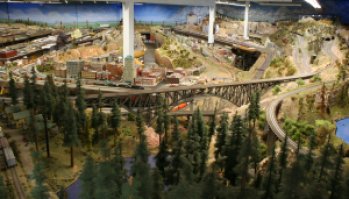
The Pasadena Model Railroad Club operates the Sierra Pacific Lines, one of the
largest HO Scale operating Model Railroads in the world covering almost 5000
square feet. The railroad has over 30,000 feet of hand laid steel rail. The
1700 foot single to quad track mainline with ten cabs allows for operating of
up to ten 30 foot trains (up to 60 cars long). Yard panels throughout the
railroad allow for operation of another 15 to 20 trains. We've even got 300
feet of traction for trolley and Pacific Electric enthusiasts and in fact are
looking for people who would be interested in expanding our traction
operations.
Sierra Pacific Lines operates trains from all eras, Steam Diesel, modern freight, old freight, classic passenger trains, and Amtrak. Breathtaking scenery, operating semaphore signals, and theatrical lighting all combine to make this Model Railroading as you always dreamed it could be. Come on by for the show of a lifetime.
Every Tuesday 7:30 - 10:00 (1st Tues Business Meeting, 2nd
Operating) & Every Saturday 1-5 & 7-10 (operating 2nd
Sat).
Visitors are always welcome!!! Regular and Associate Memberships Open!!!
The show dates for 2008 are as follows:
Spring Show - Our 68th Year:
| Saturday, April 26 | 1-5 PM and 7-10 PM |
| Sunday, April 27 | 1-5 PM |
| Tuesday, April 29 | 7:30 PM - 10 PM |
| Saturday, May 3 | 1-5 PM and 7-10 PM |
| Sun, May 4 | 1-5 PM |
Fall Show:
| Saturday, Nov 1 | 1-5 PM and 7-10 PM |
| Sunday, Nov 2 | 1-5 PM |
| Tuesday, Nov 4 | 7:30 PM - 10 PM |
| Saturday, Nov 8 | 1-5 PM and 7-10 PM |
| Sun, Nov 9 | 1-5 PM |
Open House Donations: Adults $3, Children $1 (under 7 free when accompanied by an adult)
Pasadena Model Railroad Club, Inc.
PHOTOGRAPHS
Contact:
Pasadena Model Railroad Club
E-mail: Webmaster@pmrrc.org
SIERRA PACIFIC LINES of the Pasadena Model Railroad Club -
A HISTORY
The Early Years
In April of 1940, six dedicated HO enthusiasts joined to form the Pasadena
Model Railroad Club. The first meetings were held at members' homes but soon a
club layout was started at 856 E. Maple Street and this railroad was named the
Sierra Pacific Lines. It was built with brass rail on fiber tics and powered
with 6-volt automobile batteries. The building had been a retail shop and its
total area was only 20 x 25 feet but the project attracted other capable
modelers and provided experience for the larger layouts which were to follow.
In 1956 a large downstairs storeroom became available and a second, much improved, railroad was built. The new facility was 40 x 45 feet, affording space for 570 feet of double-track main line with 10 passing sidings, each of which could handle 20-car trains. There was also space for a narrow-gauge logging branch and a trolley system. Steel flex track and high-speed, closed-frog turnouts replaced the old brass rail. During this period the club began developing its own standards for layout construction and operating equipment. Rigid adherence to these standards has resulted in quality workmanship and reliable performance. The second Sierra Pacific was operated until 1963 when construction of the 210 Freeway finally forced its abandonment.
The search for a new home led to a vacant bowling alley at 139 West Main Street in Alhambra and the third layout was begun. With more than 5,000 square feet of area, the bowling alley afforded space for a huge, single-track, point to-point system with long passing sidings and numerous industrial spurs. The railroad was planned with an operating concept based on the kind of traffic it would handle, where freight would originate and terminate, etc. In short, the Sierra Pacific was to have a realistic relationship to the economics and operation of a corresponding prototype system.
Ten mainline cabs enabled operators to move trains over the entire route from Alhambra to Zion while nineteen additional panels controlled yards, engine service and local industries. Train routing was directed by two dispatchers. A trainmaster handled overall scheduling and all operator's positions were linked by intercom. The members steadily developed the layout, adding structures, scenery and a wealth of fine detail, but it all came to an end in 1979 when the lease was not renewed and again new headquarters had to be found. This time the members were determined to settle on permanent premises!
The NEW Sierra Pacific
After several months, the present location was discovered and 21 of our members
formed a limited partnership to buy and maintain the building. This
partnership, called Sierra Pacific Associates, leased the building to the club.
The club has been gradually acquiring the individual partners' shares and now
owns the building outright.
Today's location is a big improvement over the Main Street layout. It provides more space for the railroad and we have ample facilities for a meeting room, rest rooms, individual lockers, a library and work areas. A full year was spent remodeling the building and during this time, structures, control panels and other items salvaged from Main Street were stored at members' homes. In December 1980, the new layout was started but within six months, there was a potentially disastrous setback. A late-night fire in a portion of the building, then being sub-leased, caused considerable damage and the tragic loss of some fine scratch-built structures. Damage to the building was covered by insurance but, of course, there was no way to compensate for loss of the models.
The operations plan was retained as well as the A-to-Z sequence of route names. Aside from these holdovers, the entire railroad had to be reshaped to the new building dimensions. The track plan was enlarged to fit the 70 x 72 foot room. The road was built on a grid with risers to establish the route profile. Laminated splines were attached to the risers and this base was overlaid with marine-grade mahogany plywood. The individual ties and ground walnut shell ballast were then cemented down and finally the steel rail was spiked to the ties. To insure precision track work, the club makes its own track gauges of hardened and ground tool steel. There are no rail joiners; the rail is silver-brazed in continuous lengths, interrupted only by .025 inch gaps to isolate the electrical blocks.
The main line is about 1,700 feet and at normal speeds and traffic conditions takes about an hour to traverse. The three principal yards, Alhambra, Midway and Zion, will handle a total of approximately 2,000 cars. In addition to the ten cab operators, two dispatchers and trainmaster, the completed railroad will require about 25-30 more operators to fully man the yard, branch line, and industry controls.
In February 1984, the Pasadena Model Railroad Research Center was established for the purpose of acquiring books, photographs, periodicals, motion picture film and videotapes related to all phases of railroading. This ongoing project, supported by donations is becoming a valuable historical resource. More recently a theatrical lighting system has been installed allowing trains to operate in a semi-automatically controlled 24-hour day-night sequence.
Looking Ahead
With completion of mainline trackage, late in 1985, the club has resumed
monthly operating sessions. Construction emphasis has shifted to completion of
the several branch lines serving the coal mines, ore and limestone mines, and
the lumber mill and logging operations. These branches bring raw materials and
manufactured commodities for shipment by rail (naturally) to destinations along
the line. The extensive trolley line is now operational from the port city of
Zion through Colton and Delta to Echo with a line branching off to Alhambra. We
are installing working signals on the Sierra Pacific and 1996 saw the
completion of the semaphores. Work is progressing on the searchlight signals.
Much like a real railroad we have had to relocate some trackage to improve
operations. Most notable was the realignment of the helper pocket return switch
and relocation of the east end of Powderhorn main and sidings, creating a
smoother route and a maintenance of the way siding.
1990 marked the 50th Anniversary of our club and although the major work is completed, there is much work ahead. Presently envisioned major projects; including the hidden storage yard, Urban Renewal of the City of Echo, Construction of Troy and the logging interchange, and Construction of the Port of Zion; will take several years to complete. Whatever the future brings, the Pasadena Model Railroad Club will continue to pursue its objectives to bring dedicated modelers together in good fellowship and to build an HO railroad to the highest standards for their and the public's enjoyment.
SIERRA PACIFIC SPECS & STATS (for completed railroad)
Route Distance............Main Line....................... 1,700 Feet Minimum Curve Radius......Main Line........................ 42 Inches Minimum Turnout...........Main Line...........................#8 Frog Ruling Grade ..................................................1 1/2% Maximum Grade.............Helper District..........................2% Route Time................At normal speed & traffic............1 Hour Yard Capacity (Estimated) ..........................Alhambra..........850 Cars ..........................Midway............550 Cars ..........................Zion..............600 Cars Mainline Passing Sidings...................................30-60 Feet Route Distance............Trolley System.....................300 Feet Rail......................Code 100, Steel ................30,000 Feet Crossties................................................500,000(+/-) Turnouts.....................................................400(+/-) Hookup Wire (Estimated)...................................80,000 Feet Mainline Cabs......................................................10 Dispatcher Cabs.....................................................2 Local Cabs (Yards, Industries, etc.)..........................30(+/-) Intercom Stations.................................................40+ Power Supplies (Excluding train power)............................30 Power Supplies (Selective lighting).................................6 Tunnels.......................................................25(+/-) Bridges & Trestles............................................33(+/-)
INFORMATION LINKS
Models resources - directory of Models related websites.For more Model Railroad information, visit the National Model Railroad Association (NMRA) .
For more Model Railroad information, also visit the Model Railroad Clubs of the World .
PROTOTYPE LINKS
For more model railroad club information and prototype information including the famous Tehachapi Loop Train Camera, visit the TEHACHAPI LOOP - A World-Famous Railroad Construction Achievement of the 19th Century .
SOUTHERN CALIFORNIA CLUB LINKS
For more model railroad club information, visit the Antelope Valley Model Railroad Club Train Station .
For more model railroad club information, visit the California Southern Model Railroad Club .
For more model railroad club information, visit the Gold Coast Modular Railroad Club .
For more model railroad club information, visit the Los Angeles Live Steamers .
For more model railroad club information, visit the Pacific Coast Modular Club .
For more model railroad club information, visit the Santa Susana Railway Historical Society .
Last updated: February 9, 2008
This Web page is maintained by Webmaster@pmrrc.org .